


My son went to see a Broadway show last night and sent me footage of the musicians playing the exit music.
I was mildly annoyed within the first eight bars.
What I heard were great songs from the show buried under an avalanche of 32nd note runs, fills squeezed into every available space, and enough fusion licks to make you forget you were listening to a Broadway reprise. It sounded less like a send-off and more like a jam session that nobody in the audience asked for. The songs were still in there somewhere. You just had to dig through everybody’s best material to find them.
I watched it and knew exactly what I was looking at.
The exit music is the last thing an audience carries out the door. The show is over. The story has been told. For these final few minutes, the band reprises the songs that just moved a room full of strangers to tears, to laughter, to a standing ovation. It is the last impression. The punctuation at the end of the sentence.
So why are some musicians treating it like an audition?
Drum fills nobody asked for. Chops that never showed up once during the actual performance suddenly making their debut in the exit music. Solos that have nothing to do with the songs the audience just spent two hours living inside. Every available space in the music gets filled with something. A run. A lick. A flash of technique that impresses maybe one person in the building. And that person is probably on the bandstand.
I’ve watched this happen for years and it always takes me back to the gospel chops era. Where the flashiest thing you could do became the entire point of the exercise. Where more was always more. Where the music became a vehicle for the musician instead of the other way around. Impressive to other musicians. Completely invisible to almost everyone else.
And here’s the thing. These are Broadway musicians. They earned that chair. They’re making the same money I’m making every night as the drummer for Cats: The Jellicle Ball. Union scale. A professional wage for a professional job. Nobody’s getting a bonus for degree of difficulty. Nobody’s handing out extra checks for 32nd note runs. So if they want to spend those final three minutes burning extra energy on chops the audience never requested and never needed, that’s their choice.
Just know that people are literally walking out the door while your chop fest is happening. The audience isn’t waiting for your best lick. They’re looking for the exit.
And honestly, so am I.
While everyone else is still mid-glory on the bandstand/pit, I’m already packed up, coat on, and on the train back to the Bronx. Because I did my job from the first note to the last. I don’t need three minutes of Gospel Chops at the end of the night to feel good about myself.
Which brings me back to the only question that actually matters in that pit: what’s any of this for?
Not in theory. In the moment. When the temptation’s there to add something, a fill, a run, a flash of technique, what’s it actually serving? The scene? The song? The story? Or the person playing it?
I was never the drummer with the most chops and I never really cared. What I had was intention. Every note had a reason. Every choice pointed toward the music, not toward me. Simplicity wasn’t a limitation. It was the weapon. It’s harder to sit in a groove and resist the urge to decorate it than it is to play everything you learned in music school. Restraint takes discipline. Discipline takes confidence. And real confidence means you never needed anyone in that pit to be impressed by you.
There’s a whole chapter in my book Broadway Bound and Beyond called Make It Plain. Not because it’s a catchy phrase. Because it’s the actual job description. Three words that cover everything from the first note of the overture to the last bar of exit music. And most musicians never figure it out.
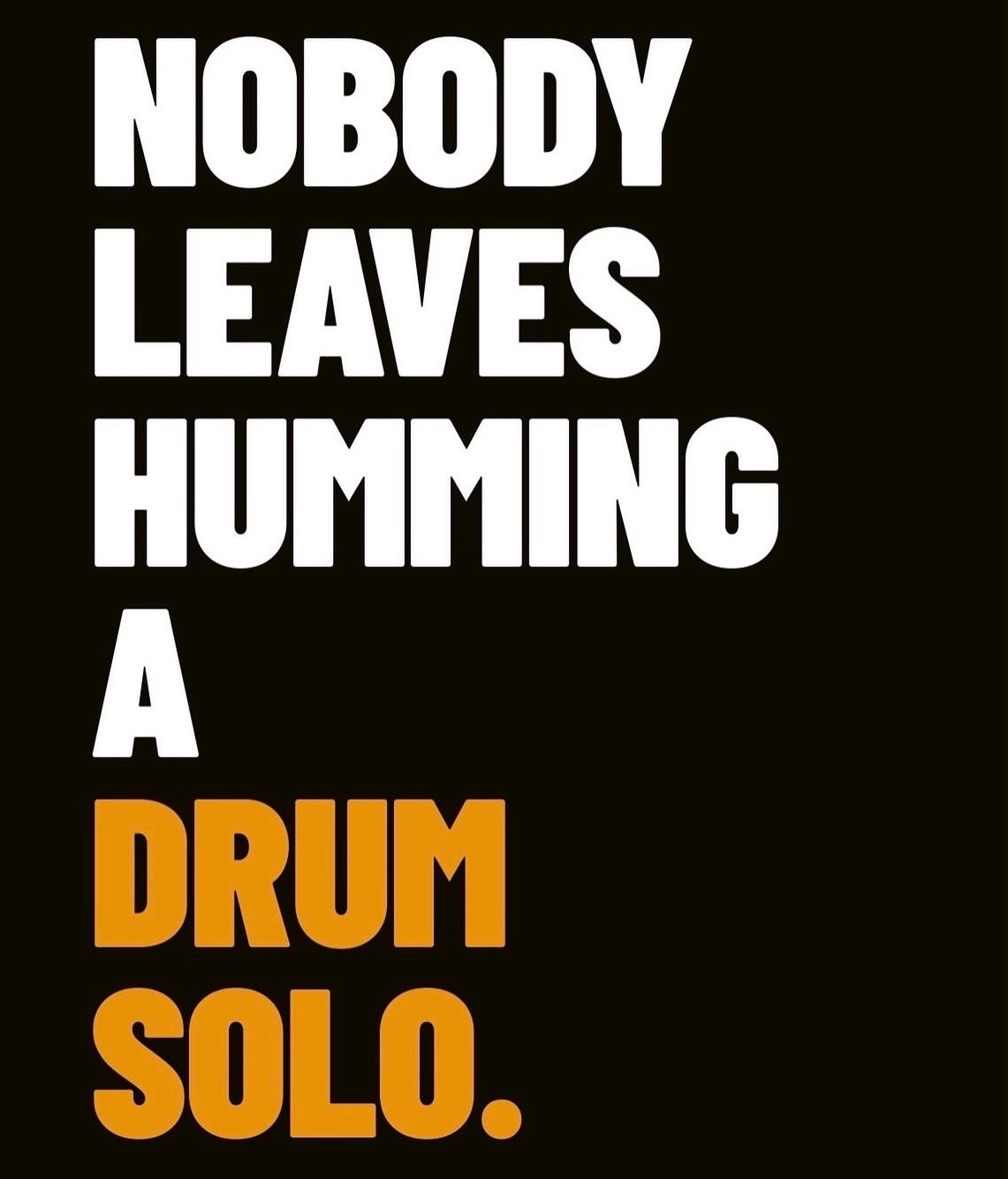
Nobody leaves the theater humming a drum solo.
They leave humming the melody that stayed with them through Act Two.
That feeling was built on every steady and intentional choice made from the first downbeat to the last bar of exit music. Not the fills. Not the runs. Not the moment you impressed the keyboard player two stands over.

The musicians who last in this business aren’t always the most talented ones. They’re not always the most technically gifted. What they understood that the flashy ones never quite figured out is simple: nobody bought a ticket for you. They bought a ticket for the show. Your job is to serve it completely, from the first note of the overture to the last note of the exit music, and then go home.
That’s what Broadway Bound and Beyond is built on. Not theory. It’s a practical framework for how you think about every note, every gig, and every career decision you’ll ever make. If you’ve ever wondered why some musicians keep working while others with more chops don’t, the answer’s in this book.
The show doesn’t end when the curtain comes down. It ends when the last person walks out that door.
Everything you play matters. Act like it.
Broadway Bound and Beyond — BroadwayBoundBook.com